
How Long Does It Take to Become an Electrician
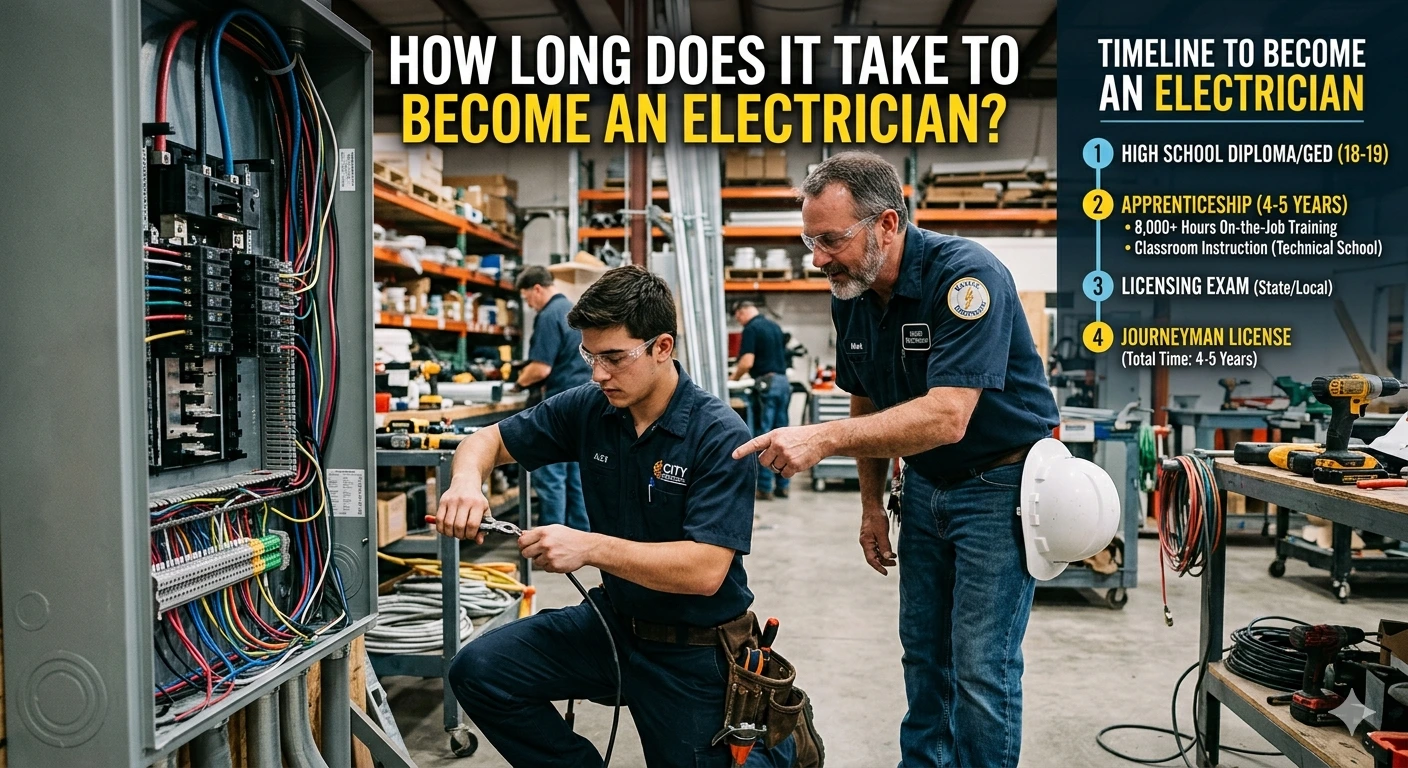
Time To Become an Electrician
Becoming a fully qualified electrician in the UK typically requires 3 to 4 years, usually through an apprenticeship. While intensive courses can deliver initial qualifications in 1.5 to 3 years, achieving industry-standard status requires balancing classroom learning with significant on-site experience.
Primary Training Routes
Apprenticeships (3–4 years): This is the most common path, offering a blend of paid, on-the-job training and college-based study.
Technical Diplomas (1.5–3 years): These are classroom-focused courses. However, you must still secure on-site work to complete the required NVQ Level 3 portfolio and the AM2 assessment.
Experienced Worker Route (Variable): Designed for those already working in the trade who need to formalize their skills into a full qualification.
Key Qualification Milestones To become an Electrician
To reach “Gold Card” status, you must move through several critical stages:
| Milestone | Description | Typical Duration |
| Level 2 Diploma | Provides foundational knowledge and basic skills. | ~7 weeks (intensive) |
| Level 3 Diploma | Covers advanced electrical theory and professional standards. | Variable |
| NVQ Level 3 & AM2 | The essential practical portfolio and final 3-day assessment of competency. | 2–4 years (including site experience) |
| ECS Gold Card | The industry standard required to work on-site as a fully qualified electrician. | Final Step |
Note: Regardless of the initial course length, gaining the practical experience required for the NVQ Level 3 and AM2 assessment is the most time-intensive part of the journey.
f you’re asking how long does it take to become an electrician, the honest answer is: it depends on the path you choose and what you mean by “fully qualified.” You can start working on site within a few months as an electrician’s mate, but reaching the industry‑recognised Gold Card standard takes years, not weeks. This guide breaks down every route so you know exactly what to expect.
What “Fully Qualified” Means – And Why the Timeline Matters
A fully qualified electrician isn’t someone who has just passed a theory exam. In the UK, the industry benchmark is:
An NVQ Level 3 Diploma in Installing Electrotechnical Systems
The AM2 Assessment (a practical trade test)
An ECS Installation Electrician Gold Card
18th Edition Wiring Regulations qualification
Without these, you are classed as an improver, mate, or domestic installer—not yet a fully‑fledged electrician. The journey to holding all of these is what defines the real timeline.
To become an electrician, there are three main training routes.
Route 1: Apprenticeship – 3 to 4 Years
This is the most common and thorough path.
Typical duration: 3.5 to 4 years
Structure: You work for an employer 4 days a week and attend college on day release or block weeks.
What you gain: Level 3 NVQ, AM2, 18th Edition, and the required on‑site portfolio – everything needed for the Gold Card.
End result: You emerge as a JIB‑recognised Installation Electrician.
An apprenticeship is the gold standard because it blends real site experience with structured learning from day one. Most people complete it in 4 years; some with prior relevant experience can finish in 3 to 3.5 years.
Route 2: College Course Followed by Site Experience – 3 to 4 Years
This route is popular for school leavers who go straight to full‑time college.
Level 2 Diploma in Electrical Installations: 1 year (full‑time)
Level 3 Diploma in Electrical Installations: 1 year (full‑time)
After these 2 years, you have strong theory knowledge but no on‑site NVQ. You must then:
Find work as an electrician’s mate or improver.
Build a portfolio of evidence while working for 1 to 2 years.
Complete the NVQ Level 3 and pass the AM2.
Overall timeline: 3 to 4 years. Some motivated individuals who secure site work quickly can finish in just over 3 years.
Route 3: Intensive Private Training – 2 to 3 Years
Private training centres offer fast‑track programmes, sometimes marketing “become an electrician in 6 weeks.” This is only part of the story.
Initial training: 6 to 12 weeks (full‑time) covering domestic installer skills, 18th Edition, Part P, and basic inspection and testing.
After the course: You hold a Domestic Installer qualification but are not yet a full electrician. You still need to:
Gain on‑site experience as an improver for 1.5 to 2 years.
Build an NVQ portfolio and sit the AM2.
Overall timeline: A realistic minimum of 2 years, often 2.5 to 3 years. Any programme claiming you’ll be fully JIB‑graded in under 18 months should be questioned heavily. Competence is built on the tools, not in a classroom.
A Timeline Summary: How Many Years for Each Step?
| Step | Approximate Time |
|---|---|
| Level 2 Diploma (college) | 1 year |
| Level 3 Diploma (college) | 1 year |
| Initial fast‑track domestic package | 3–4 months (intensive) |
| Apprenticeship (employed, day release) | 3–4 years total |
| On‑site NVQ portfolio and AM2 preparation | 1–2 years after initial theory |
| Gaining Inspection & Testing (2391) | 1–2 courses, often 5‑day blocks |
| Becoming self‑employed & Part P registered | Can be done alongside final stages |
Bottom line for the UK: Regardless of the route, expect to commit 3 to 4 years to become a fully‑fledged installation electrician with a Gold Card. Any shorter, and you’re likely qualified at a limited scope only.
How Long Does It Take to Become a specialist as an electrician?
Once you’re fully qualified, adding skills usually takes:
Inspection & Testing (2391‑52): 1 week intensive course + exam. Competence builds over 3–6 months of real‑world testing.
EV Charger Installation: 1–2 days of specialist training.
Solar PV Installation: 1–2 weeks.
Fire Alarm & Emergency Lighting design: 1‑day courses, but depth comes with site work.
Specialisms add to your earning power quickly, usually within weeks of training.
Can You Shorten the Timeline?
You can slightly, but not drastically. Here’s what helps:
Prior relevant experience: If you’ve already worked as a mate or come from a technical background, you may complete the NVQ portfolio faster.
Working for a supportive employer: One that exposes you to varied jobs speeds up your evidence gathering.
Intensive college and private training: Condensing the classroom phase shortens the front end, but the on‑site hours are still mandated.
No accreditation body waives the core on‑site assessment (AM2) or the portfolio requirement. Safety is the reason the timeline exists.
How Long to Become an Electrician in Other Countries
If you’re considering relocating, here’s how the timeline compares.
United States: 5‑year apprenticeship (union IBEW) or 4‑year non‑union, including 8,000–10,000 hours on the job. Journeyman license after passing the exam.
Australia: 4‑year apprenticeship, leading to a Certificate III in Electrotechnology and an A‑Grade licence.
Canada: 4 to 5 years, 9,000 hours of workplace experience and technical training blocks, ending with the Red Seal certification.
New Zealand: 3.5 to 4 years, NZ Certificate in Electrical Engineering Theory and Practice plus EWRB licence.
The pattern is similar worldwide: 4 years is the international norm for full trade qualification. Some countries allow fast‑track entry for experienced migrants, but the apprenticeship duration is rarely under 3 years.
What Happens If You Only Do a Short Domestic Installer Course?
You’ll be trained to carry out standard domestic work—like consumer unit changes, socket additions, and basic rewires—in your own home county. However:
You won’t have an NVQ or AM2, so you cannot get a JIB Gold Card.
You may be restricted from commercial and industrial sites.
Many employers won’t recognise you as a fully qualified electrician.
Your earning ceiling will be lower.
If your ambition is simply to do local domestic jobs and you register with a competent person scheme, you can start trading within a few months of completing the course. But know the distinction: you’ll be a domestic installer, not a full electrician by industry definition.
Summary
Minimum time to work on site as a mate: 2–3 months (Domestic Installer course).
Minimum time to become a fully graded Electrician (Gold Card): 3 years in the fastest realistic scenario; 4 years is the standard.
Time to become self‑employed: Often during the final year or immediately after the AM2, if you have the capital and confidence.
How long does it take to become an electrician? To achieve the complete qualification that opens every door, plan for 3 to 4 years. It’s a stretch, but at the end you hold a trade respected across the world, with a lifetime of opportunity ahead of you.
FAQs
What is the fastest way to become a qualified electrician?
The fastest classroom-based route involves intensive Level 2 and Level 3 diplomas, which can be completed in roughly 1.5 to 3 years. However, you cannot be considered “fully qualified” until you complete your on-site NVQ Level 3 portfolio and the AM2 assessment, which generally requires at least 2 to 4 years of total experience.
Can I become an electrician in 6 months?
While you can gain basic knowledge or specific domestic installer certificates in a few months, you cannot become a fully qualified, industry-standard electrician in that timeframe. A Level 2 Diploma alone can take around 7 weeks of intensive training, but this is only the first milestone.
How long does an electrical apprenticeship take?
An apprenticeship is the most common and comprehensive route, typically taking 3 to 4 years to complete. It balances paid on-the-job training with scheduled college study.
What qualifications do I need to be a fully qualified electrician?
To reach full, industry-standard status, you must achieve an NVQ Level 3 and pass the AM2 (Achievement Measurement 2) assessment. This allows you to apply for an ECS Gold Card, which is required to work independently on most UK construction sites.
How long is the AM2 test?
The AM2 assessment itself usually takes 3 days. However, you can only sit for this exam after completing your Level 3 technical qualifications and gathering months or years of practical site experience for your portfolio.
Is it hard to become an electrician without an apprenticeship?
It is possible, but often more challenging. You can take Electrical Diplomas (1.5–3 years) in a classroom setting, but you must still find a way to gain on-site experience to complete your NVQ Level 3. Without an employer to back you, securing that site work can be difficult.
How long does the “Experienced Worker Route” take?
The duration for the Experienced Worker Route is variable. It is designed for individuals who have worked in the industry for years but lack formal papers, allowing them to bridge the gap to full qualification based on their existing knowledge.
What is the difference between Level 2 and Level 3 Diplomas?
Level 2: Focuses on foundational knowledge and basic initial skills.
Level 3: Provides the advanced electrical theory and understanding required for professional-level work.
Can I work as an electrician while I am still training?
Yes, especially through an apprenticeship, where you are paid to learn on the job. Trainees often work as “electrician’s mates” or “improvers” while they finish their NVQ portfolio.
How long does it take to get an ECS Gold Card?
You can only apply for an ECS Gold Card once you have completed your Level 3 training, NVQ, and AM2 assessment. Most people reach this stage after 3 to 4 years of dedicated training and work.
Can I become an electrician at 30?
Yes. There is no upper age limit for becoming an electrician in the UK. Many adults successfully career-change at 30, 40, or even 50. The primary barriers are often financial (accepting lower “apprentice” wages during training) rather than age-related.
Is 25 too late to start an apprenticeship?
Absolutely not. Government statistics show that nearly half (48%) of all apprenticeship starters are aged 25 and over. Employers often value the maturity and previous life experience that older apprentices bring to the team.