
What Is a PLC Electrician?
A PLC electrician is a specialised electrician who installs, wires, programs,
and maintains Programmable Logic Controllers (PLCs) the industrial computers
that automate machinery, production lines, and control panels. Unlike a general
domestic electrician, a PLC electrician combines standard electrical training
with programming and automation skills, working mainly in factories, plants,
and commercial or industrial sites rather than homes.
Quick Overview
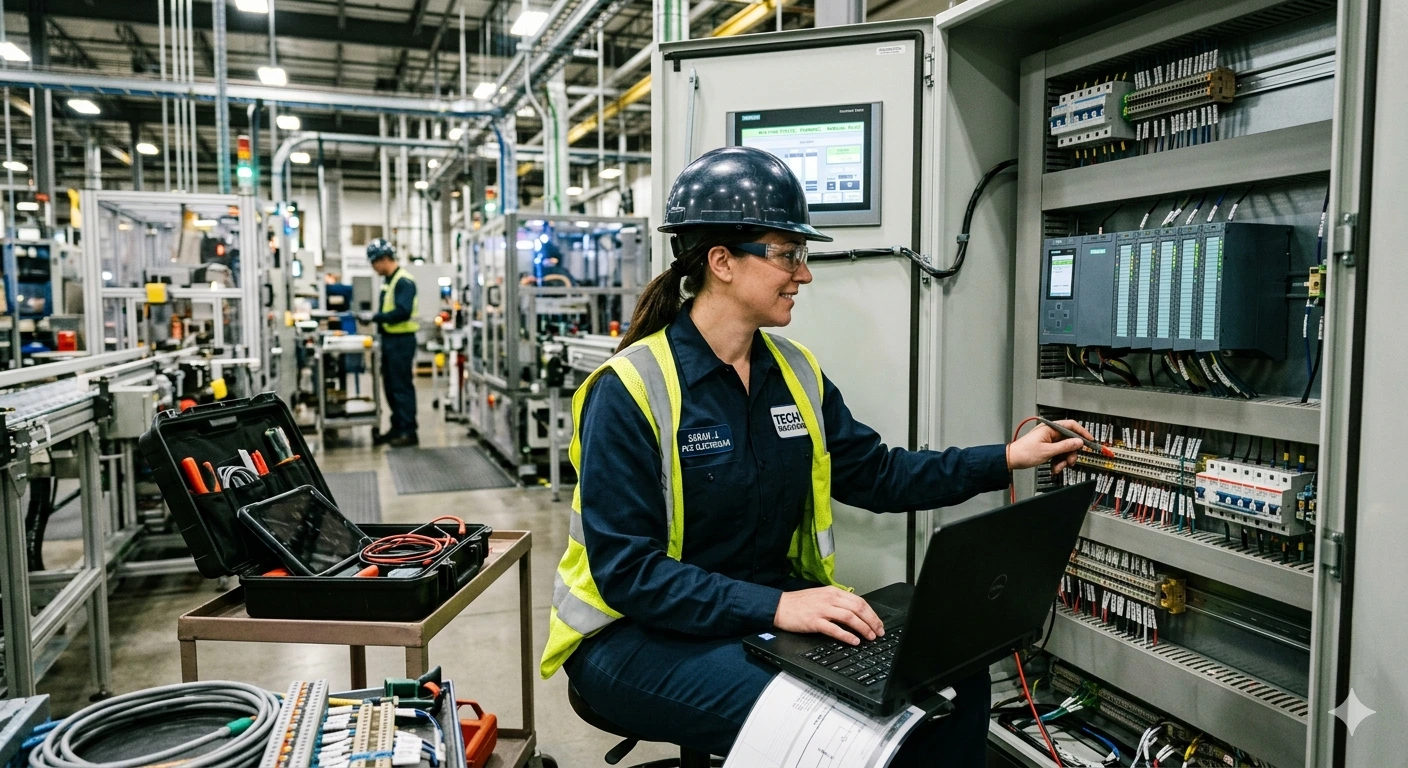
A PLC (Programmable Logic Controller) electrician is a specialised industrial electrician responsible for installing, programming, maintaining, and troubleshooting computer-based control systems used to automate manufacturing and industrial processes. They connect inputs such as sensors and switches to outputs like motors, conveyors, and valves through PLC controllers. PLC electricians also modify ladder logic software to improve automation performance and keep production systems running efficiently.
Key Responsibilities
Troubleshooting
Using diagnostic software and testing equipment to identify faults in automated systems, including faulty sensors, damaged PLC hardware, wiring issues, or communication failures.
Programming & Modification
Editing ladder logic programs to adjust sequence operations, improve automation efficiency, and optimize industrial machinery performance.
Installation & Maintenance
Installing PLC wiring, conduits, control panels, and automation systems while carrying out regular preventative maintenance to reduce downtime.
System Documentation
Maintaining software backups, technical drawings, electrical schematics, maintenance reports, and documentation for system updates and revisions.
Common Work Environments
PLC electricians mainly work in industrial and automated environments, including:
- Manufacturing plants
- Food processing facilities
- Automated warehouses
- Packaging industries
- Automotive factories
- Industrial production sites
Alternative Job Titles
- Controls Technician
- Automation Technician
- PLC Programmer/Technician
- Industrial Electrician
- Control Systems Technician
Required Skills
PLC electricians often need strong knowledge of electrical circuits, industrial automation systems, and technical schematics. They should also be familiar with PLC software, ladder logic programming, digital signals, sensors, relays, and field devices to effectively troubleshoot and maintain automated systems.
What Is a PLC Electrician?
A PLC electrician sits at the intersection of electrical installation and industrial automation. While a standard electrician focuses on wiring, containment, and power distribution, a PLC electrician adds programming, fault‑finding on automated systems, and control panel expertise to their toolkit. If you’ve seen a factory production line, a baggage handling system, or an automated packing machine, a PLC electrician was almost certainly involved in getting it running.
What Does PLC Stand For?
PLC stands for Programmable Logic Controller.
It’s a rugged industrial computer that controls machinery, process lines, and automated equipment. Instead of hard‑wired relay logic, a PLC uses a program to read inputs (sensors, switches, buttons), make decisions, and control outputs (motors, valves, lights, actuators).
A PLC electrician is the person who installs, wires, troubleshoots, and often programs these controllers and the electrical systems they command.
What Does a PLC Electrician Do?
A PLC electrician blends electrical installation with control systems engineering. Their daily work can include:
Installing and wiring PLC control panels, motor starters, VSDs, and instrumentation
Reading and interpreting PLC ladder logic, function block, or structured text programs
Commissioning new machinery and automated systems on site
Fault‑finding on live production equipment using PLC diagnostics software
Modifying existing PLC programs to change machine behaviour
Connecting PLCs to SCADA, HMI touchscreens, and plant networks
Calibrating sensors, transmitters, and actuators
Carrying out planned preventative maintenance on automated plant
Working with other engineers to integrate robotics, conveyors, and safety systems
Documenting changes to programs and electrical schematics
The role is hands‑on. You’re as likely to be inside a panel with a multimeter as you are to be plugged into a PLC with a laptop.
Key Skills Every PLC Electrician Needs
| Skill Area | What It Means in Practice |
|---|---|
| Electrical installation | Wiring panels, trunking, containment, and field devices to BS 7671 and industry standards |
| PLC programming | Understanding and editing ladder logic, function block, SFC, and structured text (Siemens, Allen‑Bradley, Mitsubishi, Omron) |
| Fault finding | Using PLC diagnostics, electrical test instruments, and logic analysis to trace faults quickly |
| Reading schematics | Interpreting electrical drawings, P&IDs, and PLC I/O schedules |
| VSD and motor control | Setting up and troubleshooting variable speed drives and soft starters |
| Instrumentation | Working with 4‑20mA, 0‑10V, thermocouples, pressure transmitters, and level sensors |
| Networking | Understanding industrial protocols: Profinet, Profibus, Ethernet/IP, Modbus |
| Safety knowledge | Wiring emergency stops, safety relays, light curtains, and trapped‑key systems to SIL/PL requirements |
| IT literacy | Configuring IP addresses, connecting laptops, and using PLC software |
| Communication | Explaining technical issues to operators and production managers without jargon |
What Industries Employ PLC Electricians?
PLC electricians are needed in any sector that relies on automation. Common employers include:
Food and beverage manufacturing – bottling lines, packaging, conveyor control
Automotive – robotic welding cells, assembly lines, paint shops
Pharmaceuticals – clean‑room filling lines, tablet presses, environmental monitoring
Water and wastewater – pump control, chemical dosing, telemetry
Energy and power generation – turbine control, substation automation, SCADA
Logistics and warehousing – automated sortation, palletisers, ASRS systems
Airports – baggage handling, airbridge systems, fuel pumps
Oil and gas – wellhead control, pipeline monitoring, safety shutdown systems
Virtually any factory or processing plant with moving machinery has PLC systems, and therefore needs PLC electricians to keep them running.
PLC Electrician vs Standard Electrician: What’s the Difference?
| Aspect | Standard Electrician | PLC Electrician |
|---|---|---|
| Main focus | Fixed wiring or rewiring, power distribution, lighting, general installation | Control panels, automation, instrumentation, and PLC programming |
| Electrician Tools | MFT, hand tools, power tools | Multimeter, laptop with PLC software, signal calibrators |
| Core knowledge | BS 7671, 18th Edition, cable calcs, safe isolation | PLC logic, industrial networking, VSDs, instrumentation, P&IDs |
| Typical environment | Domestic, commercial, construction sites | Factories, process plants, industrial facilities |
| Certification | NVQ Level 3, AM2, ECS Gold Card, 2391‑52 | Same electrical foundation, plus PLC programming courses and manufacturer training |
| Work pattern | Often day shifts, some call‑out | Often shifts or on‑call for 24/7 production lines |
Many PLC electricians start out as qualified installation electricians, then move into industrial maintenance and pick up the automation skills over time.
What Qualifications and Training Do You Need to become PLC Electrician?
There is no single “PLC electrician” qualification, but the typical path looks like this:
Become a fully qualified electrician first. You’ll need the standard electrical foundation: NVQ Level 3, AM2, 18th Edition, and ideally an ECS Gold Card. Most employers won’t let you near a panel without this.
Gain industrial experience. Work as a maintenance electrician in a factory or process plant to understand motors, sensors, and control panels in real‑world conditions.
Learn PLC basics. Short courses from manufacturers (Siemens, Allen‑Bradley / Rockwell, Mitsubishi, Omron) or independent training providers. A typical introductory course runs 3–5 days and covers:
Hardware configuration
Ladder logic and function block programming
Forcing inputs/outputs for testing
Fault diagnostics
Develop on the job. Most real PLC fluency is built by troubleshooting real machines alongside experienced automation engineers.
Add advanced courses over time: SCADA, HMI design, industrial networking, safety PLCs, robotics integration.
Optional certifications include:
City & Guilds 2396 (Design, Erection and Verification) for control panel design
CompEx (for hazardous areas)
Manufacturer‑specific certification (Siemens S7, Rockwell ControlLogix)
HNC/HND in Electrical or Electronic Engineering for deeper theory
How Much Does a PLC Electrician Earn in the UK?
PLC electricians command a premium over standard domestic or commercial electricians because of the specialist automation skills.
| Experience Level | Typical Annual Salary (UK) |
|---|---|
| Newly qualified electrician moving into industrial maintenance | £28,000 – £34,000 |
| Industrial maintenance electrician with basic PLC skills | £34,000 – £42,000 |
| Experienced PLC electrician (fault finding and minor programming) | £42,000 – £52,000 |
| Senior PLC / automation electrician (full programming & commissioning) | £50,000 – £65,000+ |
| Contract PLC electrician / commissioning engineer (self‑employed) | £30 – £55 per hour (often with expenses paid) |
Shift allowances, overtime, and on‑call payments can push these figures considerably higher. Contracting engineers who travel for commissioning projects often earn the most.
Is a PLC Electrician the Same as a PLC Programmer or Automation Engineer?
No, though the roles overlap.
PLC Electrician: A time‑served electrician who wires, installs, and fault‑finds PLC hardware and electrical circuits, with some programming capability. The emphasis is on the electrical installation, safety, and practical fault‑finding.
PLC Programmer: Often comes from a software or engineering background. They write the PLC code, design the HMI screens, and develop the control philosophy. They may have limited on‑site electrical installation skills.
Automation Engineer: A broader role that includes system design, PLC programming, SCADA, networking, and project management. Usually degree‑qualified but may not hold electrical installation qualifications.
In many factories, the lines blur. A skilled PLC electrician may do everything from panel wiring to complex program modifications, especially on night shift when the engineers aren’t on site.
Typical Day in the Life of a PLC Electrician
Morning handover: Review the previous shift’s log. Check which machines had faults, which are due for planned maintenance.
First call: A conveyor motor won’t start. Plug laptop into the PLC, check the output isn’t energised. Trace back through the ladder logic – a safety limit switch isn’t making. Inspect the switch, find it’s not adjusted properly after a mechanical repair. Re‑align and test.
Mid‑morning: Install a new instrument (a temperature transmitter) on a process vessel. Run 4‑20mA signal cable back to the PLC analogue input card. Update the I/O schedule and test the reading on the HMI.
Afternoon: Modify a small section of PLC code per a production manager’s request. Download the change, verify it works, and update the backup. Write a brief record for the maintenance log.
Late shift cover: A packaging machine stops with a fault code. Connect, read the diagnostics buffer, identify a VSD trip. Reset, jog the drive, confirm smooth mechanical operation, and release the machine back to production.
No two days are the same – one reason many electricians love moving into PLC work.
How to Get Into PLC Electrical Work
If you’re already a qualified electrician:
Find an industrial maintenance role. Even as a basic maintenance spark, you’ll be exposed to control panels, sensors, and PLC hardware.
Ask to shadow the automation engineer. Most experienced PLC guys are happy to pass on knowledge if you show interest.
Take a short PLC course. Siemens S7‑1200/1500 and Rockwell Allen‑Bradley are the two most common platforms in the UK. A 5‑day introduction with hands‑on programming will transform your confidence.
Volunteer for call‑out. Night shifts and breakdown cover are where you learn fastest.
Keep a notebook. Record every fault you solve, every PLC model you touch, every lesson learned. That record becomes your evidence for competency and promotion.
Common Questions About PLC Electricians
What is a PLC in electrical terms?
A PLC (Programmable Logic Controller) is an industrial computer used within an electrical panel to automatically control machinery and processes, based on input from sensors and switches.
What does PLC stand for in electrical systems?
PLC stands for Programmable Logic Controller — a device that reads electrical signals, processes them against a stored program, and sends commands to motors, relays, valves, or other equipment.
Can a regular electrician program a PLC?
A general electrician can usually wire a PLC into a panel, but programming it requires additional training in ladder logic and automation software. Many electricians add this as a specialism through further courses.
What industries use PLC electricians?
PLC electricians work across manufacturing, food and beverage production, automotive assembly, warehousing and logistics, water treatment, and any industry relying on automated machinery or process control.
Do I need a degree to be a PLC electrician?
No. A solid electrical apprenticeship and NVQ Level 3 are the foundation. The PLC skills are added through short courses, manufacturer training, and on‑the‑job experience.
Can a domestic electrician become a PLC electrician?
Yes, but you’ll need to move into an industrial environment first. The transition from domestic work to three‑phase industrial systems takes time and a willingness to learn new concepts like control logic, instrumentation, and networking.
What is the difference between a PLC electrician and a maintenance electrician?
A maintenance electrician looks after all electrical systems in a plant (lighting, power, motors). A PLC electrician specialises in the automated control systems and the interface between the PLC and the plant. In practice, many industrial electricians do both.
Is PLC work hard to learn?
It is logical and methodical. If you can fault‑find an electrical circuit, you can learn to read ladder logic. The programming syntax takes practice, but the underlying thought process is the same structured, step‑by‑step approach that good electricians already have.
Do PLC electricians travel a lot?
Some do. Commissioning engineers often travel to install and start up machinery at client sites across the UK and sometimes abroad. In‑house maintenance PLC electricians tend to work at one site with occasional off‑site training.
Final Words
A PLC electrician is a skilled electrician who has added the ability to work with programmable logic controllers—the brains behind modern automated machinery. They combine hands‑on electrical installation with diagnostic software, ladder logic modifications, and instrumentation expertise. It’s a career step that brings more variety, higher pay, and genuine job security in an increasingly automated world.
If you’re already an electrician and enjoy solving complex problems, working with technology, and keeping critical production lines moving, becoming a PLC electrician could be one of the best moves you ever make.